



ABSTRACT
Treating a political party as a firm and its leader as a chief executive, this paper reads a post-defeat party-congress address as management's account of a catastrophic year. A sentence-level content analysis of the full speech (252 statements, 2,708 words, 32 minutes) codes every unit against the four Ps of marketing and three further dimensions: self-versus-other reference, valence, and the attribution and depth of each stated cause of defeat.1 The address devotes two-thirds of its substantive time to the party itself, yet of ten enumerated causes of the loss only one concerns the product, and none holds that the product was wrong. Roughly a third to two-fifths of the causal account is directed outward; among the causes management does own, execution failures outnumber substance failures by close to four to one; and the party's own offer is defended two-to-one over any self-criticism. Judged as a shareholder communication, the document is a competent campaign post-mortem that never audits the product or the brand. The paper reads this as the price of illusionism — a narrative-first governing model that treats substance problems as communication problems — visible at the moment the model fails twice over: the illusion stops working on the electorate it most needed, and its author can no longer recognise the failure as his own. It is, in the end, a case of the narrative-only accountability that lets an underperforming chief executive author, and survive, the story of his own defeat.
01
The company, the CEO, and the annual letter
Imagine the party as a listed company. Members and voters are the shareholders, the leader is the chief executive, the parliamentary group is the board, and the statistical offices and the election authority are the auditors who publish the accounts. An election is the annual general meeting where the management contract is renewed — or terminated. On this occasion, after four consecutive supermajorities and sixteen years in office, the contract was terminated: the company lost, heavily, and passed into opposition. The congress address analysed here is what the chief executive said to the shareholders immediately afterward. It is the annual letter written after the worst year in the company’s history.
An earlier piece in this series argued that a stable but underperforming political CEO should be red-carded (see Would You Red Card Your CEO? Beyond Stability — Benchmarking Orbán’s Government Against Its Regional Peers) the way activist investors force out management that trails its sector for a decade. It ended with a reader’s question: run a failure analysis — why did the company end up here? This paper takes that literally. It doesn’t re-run the economic scorecard; it audits the failure analysis the chief executive delivered himself, and asks whether it meets the standard a board would demand after a miss of this size.
There is a specific prior expectation to test. An earlier essay on political branding proposed a mechanism: when the underlying product falters, the messaging grows louder to compensate. The 2026 defeat speech is the natural experiment. The product has now demonstrably failed — the company lost its mandate. Does management finally turn to examine the product? Or does it reach for more messaging?
02
The method, briefly
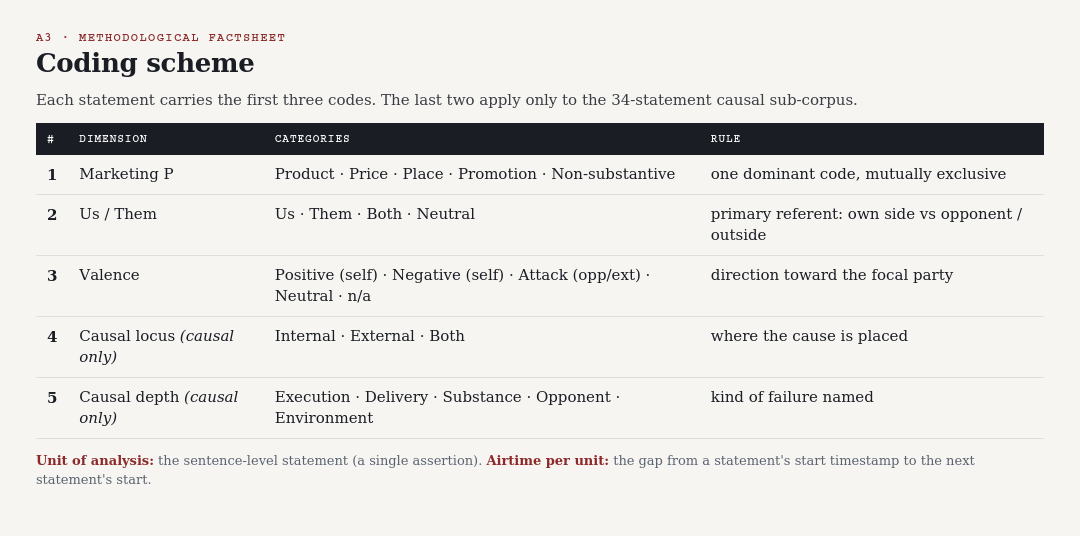
The no frills lens is deliberately a business one: the four Ps of marketing, adapted to a party. Product is the offer — platform, governing record, leadership, brand identity. Price is the non-monetary cost of choosing it — taxes, risk, the promises made. Place is distribution and reach — channels, ground game, digital. Promotion is the communication itself. The frame earns its keep because it separates two things ordinary commentary blurs: criticism of what a company offers from criticism of how it sells that offer.
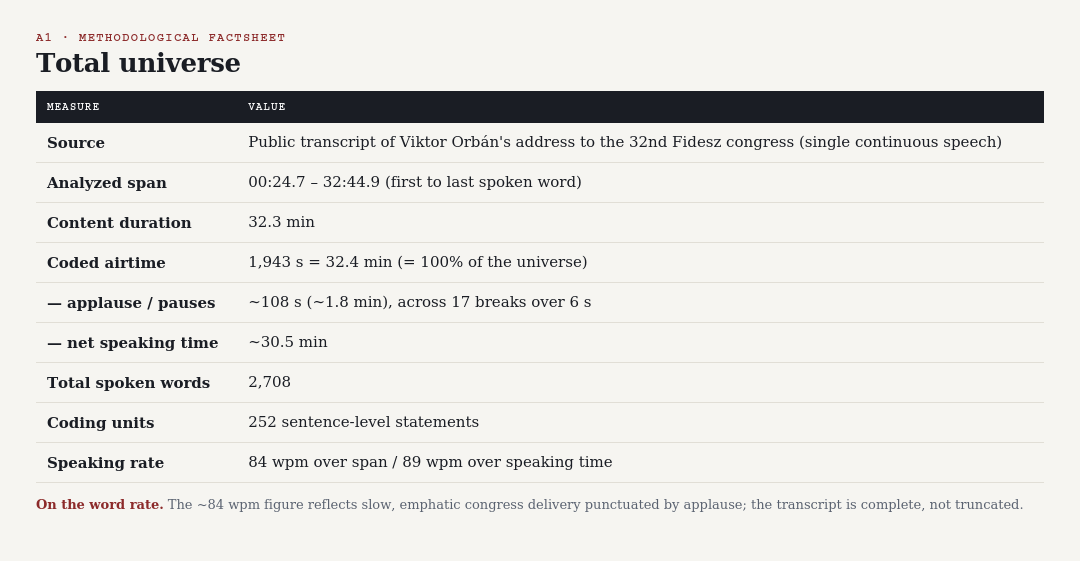
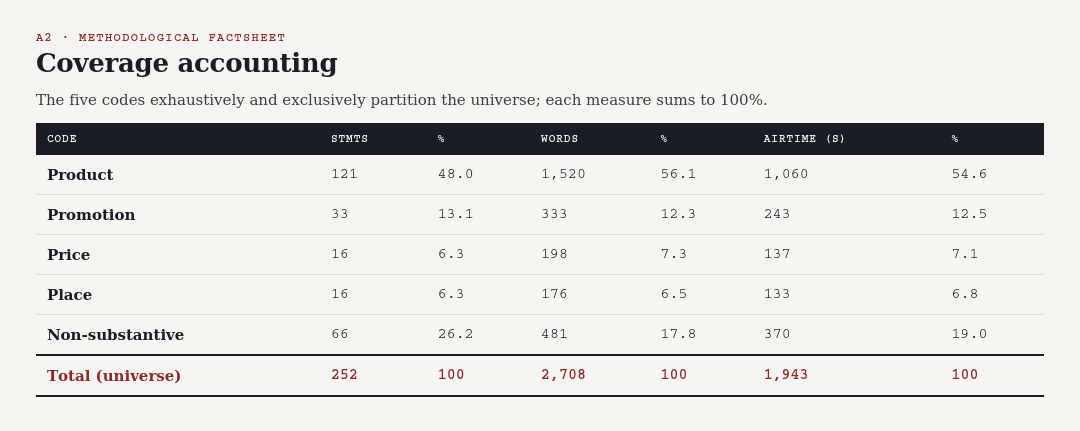
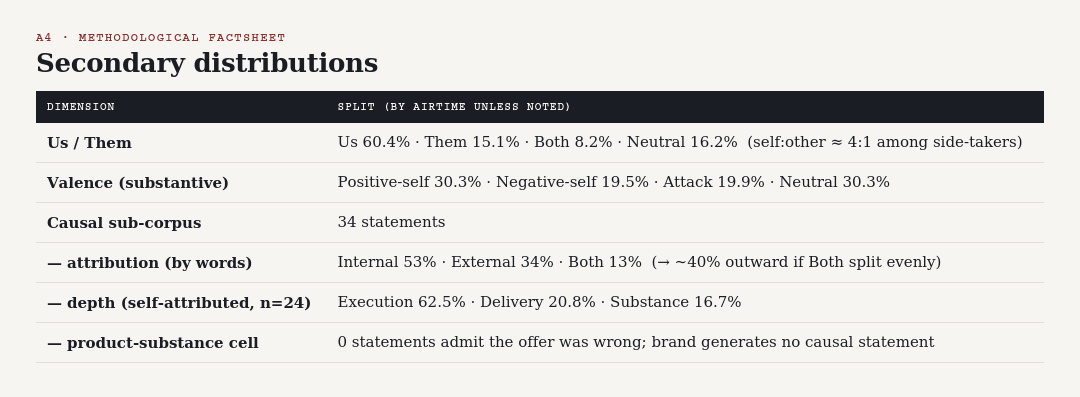
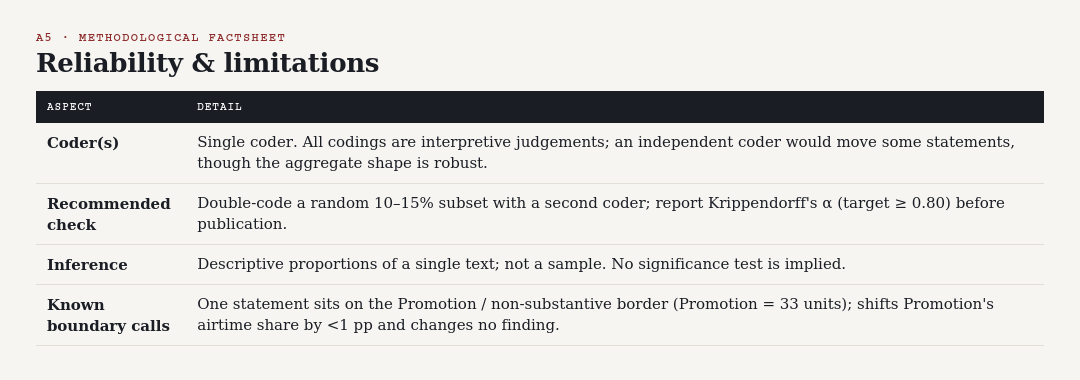
The full speech was segmented into 252 sentence-level statements, each assigned one dominant P (plus a residual for greetings and ceremony). Because the transcript is time-stamped, attention is measured three ways — mentions, words, and seconds of airtime. Three further dimensions were coded: self-versus-other reference, valence (positive or negative about one’s own side), and, for the statements that explicitly explain the loss, the attribution (internal or external) and depth (execution, delivery, or substance) of each cause. Full universe, coverage and per-statement data are in the methodological factsheet accompanying this piece.
03
Where the speech spends its attention
By airtime, one category dominates: the product — the record, the values, the reorganisation, the leadership — takes roughly two-thirds of all substantive speaking time. Read naively, this looks like a company examining itself. That reading collapses once the attention is weighted for valence and located inside the causal section.
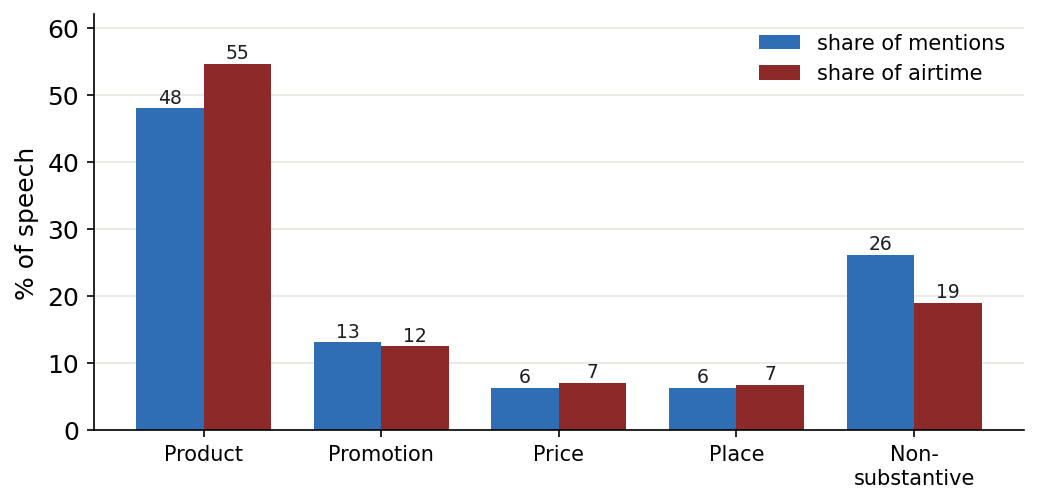
Fig. 1 — Share of mentions vs. share of airtime, by category. The two measures agree except for the short ceremonial residue.
The ten stated causes
The decisive passage is narrower than the whole speech: the ten enumerated reasons for the defeat. Here the product all but disappears as a cause, its large overall airtime notwithstanding.
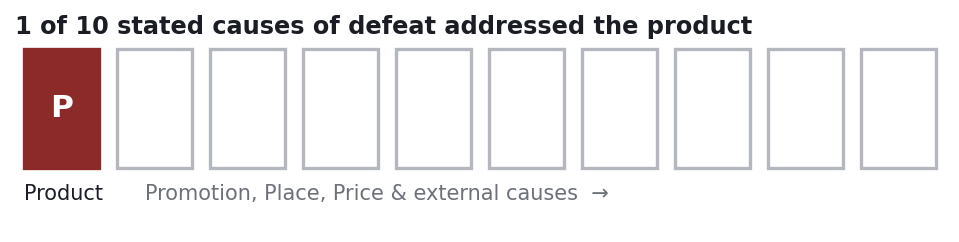
Fig. 2 — One of ten enumerated causes addresses the product; the product is never called wrong.
Seven of the ten points concern campaign execution — the message and the channels (which is not a coincidence at all, since after a few years of persuasive branding Orbán’s communication hardened into propaganda, wrote about this Beyond Branding: Us vs. Them Orbán’s Shift from Persuasion to Friend–Enemy Propaganda). One concerns Price (the opponent’s unfunded promises against the company’s restraint). Exactly one concerns Product — and it does not call the offer wrong; it says growth was not delivered, blames the war and Brussels, and defends the company’s targeted measures as successes.
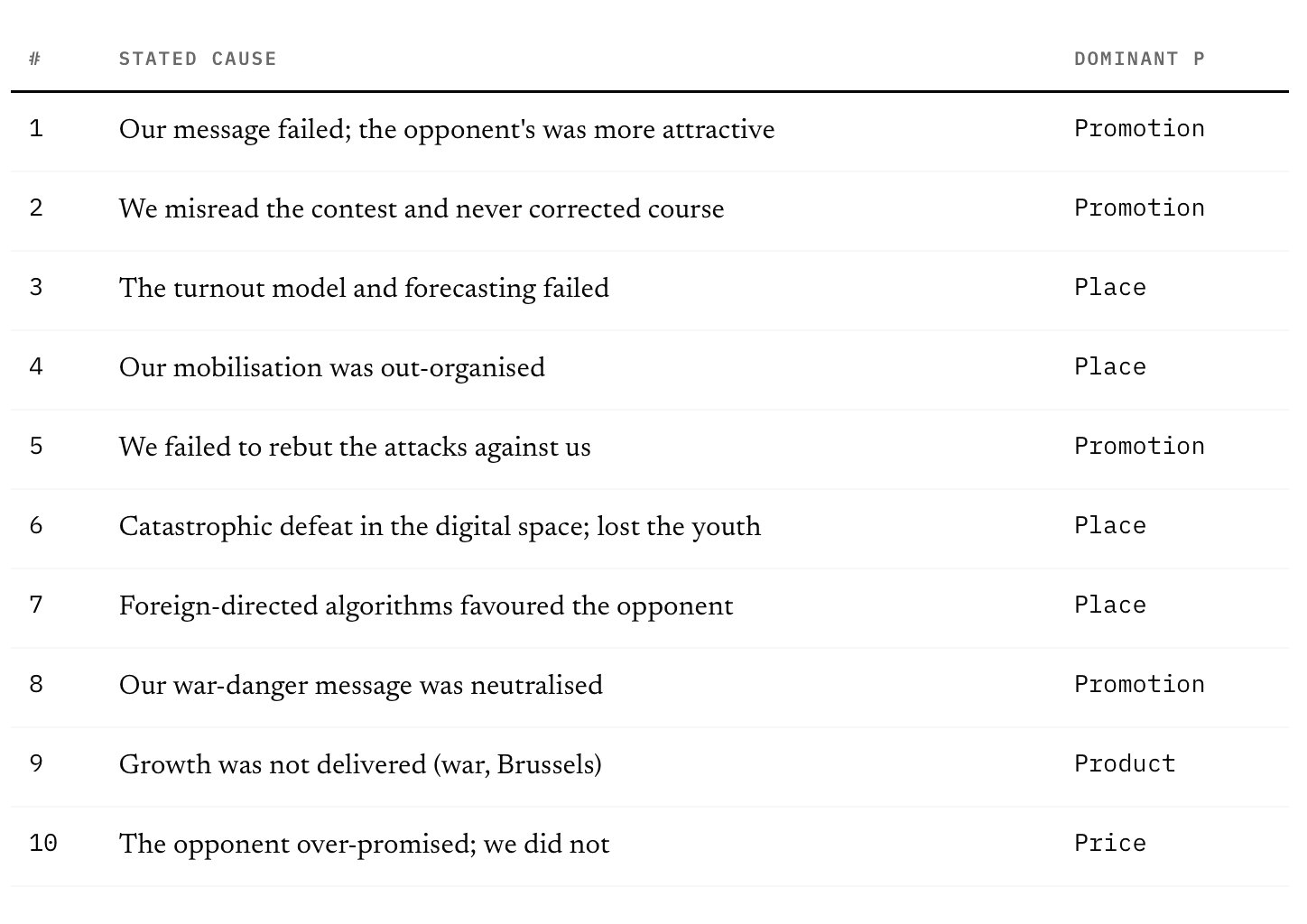
Across the entire diagnosis, the company never identifies its policies, its record, its leadership or its sixteen-year incumbency as a reason it lost.
04
Self and other: who the speech is about
The address is overwhelmingly inward-facing — about 60% of airtime is us, about 15% them. But the outward-facing material is not spread evenly; it concentrates in two registers, and the split is almost clean.
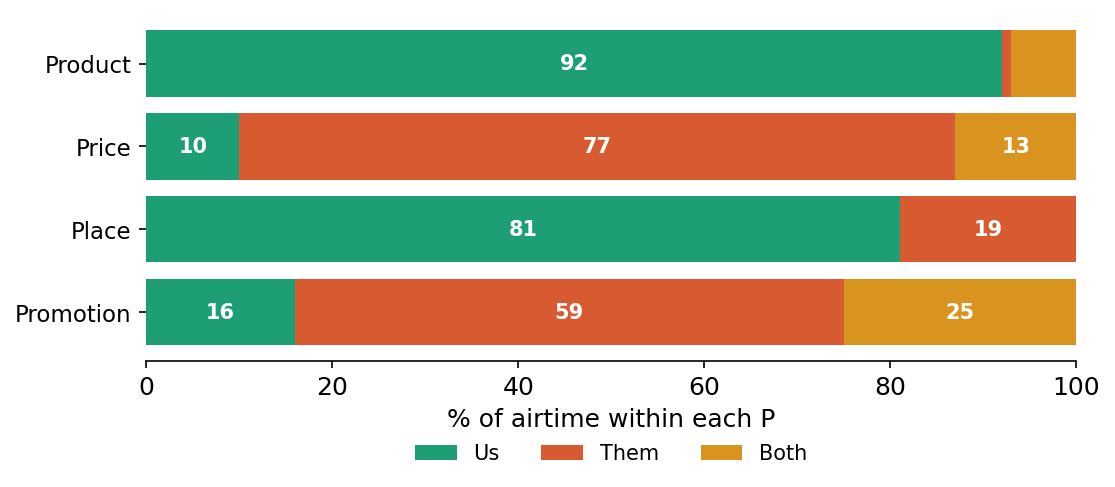
Fig. 3 — Us / them / both within each marketing P’s, by airtime. The offer is discussed as us; cost and attack as them.
When the company speaks of its product, it speaks about itself (92% us). When it speaks of cost and risk or turns to attack, it speaks about the opponent. The template: characterise ourselves when discussing the offer; characterise the opponent when discussing cost, risk and conduct.
05
Praise and criticism: the valence of self-talk
The most revealing cut is valence — and it overturns the naive reading. When the company talks about its own product, is it examining it or defending it?
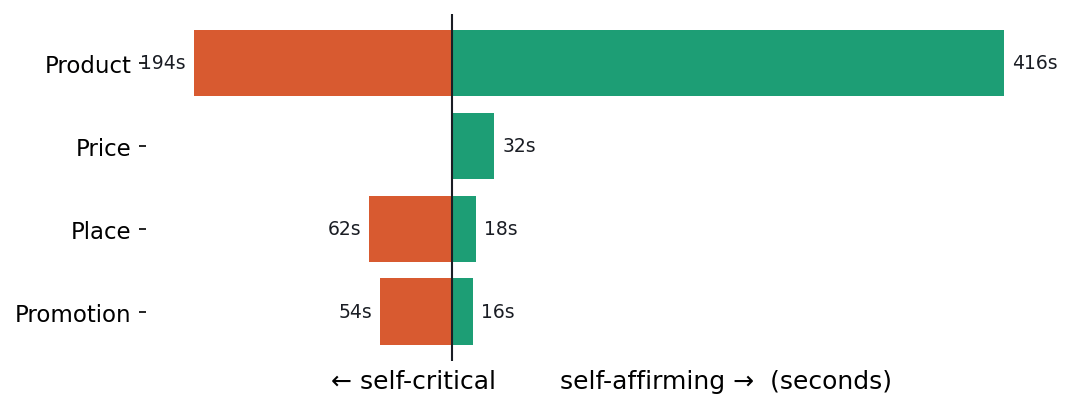
Fig. 4 — Positive vs. negative self-talk, by airtime seconds. Product is defended; Place and Promotion carry the self-criticism; Price is never faulted.
Product is the defence showcase: self-talk about the offer runs better than two-to-one positive. The two-thirds of airtime spent on Product is overwhelmingly the company defending its offer, not interrogating it. Price is never faulted at all. Place and Promotion are the confession booth — but the self-criticism there is small in volume, and Promotion’s airtime is dominated by attacking the opponent, not self-examination.
06
Attribution and depth: the anatomy of the excuse
Coding the causal statements by where the fault sits and what kind of fault it is completes the picture.
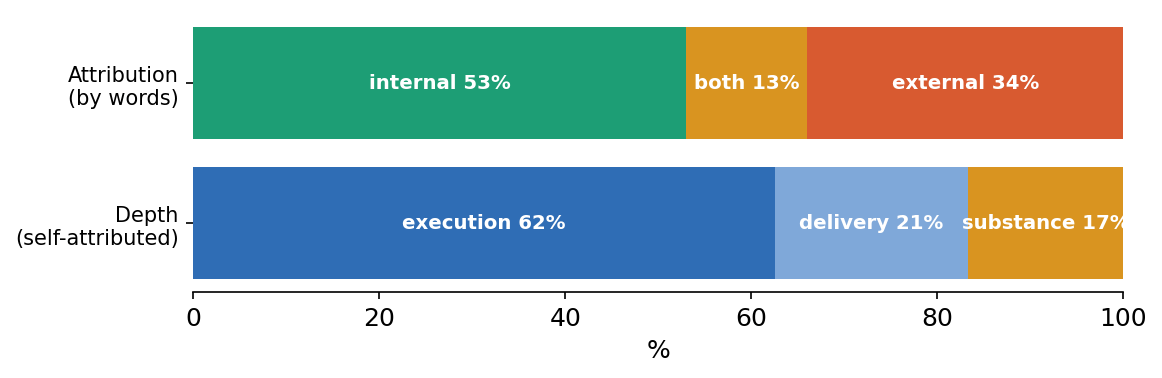
Fig. 5 — Attribution of causes (by words) and depth among self-attributed causes. Roughly a third to 40% is directed outward; substance is the smallest share.
Two of every five words explaining the defeat locate its cause outside the company — the war, Brussels, the algorithms, the opponent. And of the causes management does own, the overwhelming majority concern execution, not substance. Even the thin substance sliver is weaker than it looks: two statements concede that voters rejected the offer rather than that the offer was wrong; one reframes the refusal to over-promise as a virtue; the only unambiguous substance critique concerns the message, not the offer.
Lay the four Ps against how each is treated, and one cell is empty.
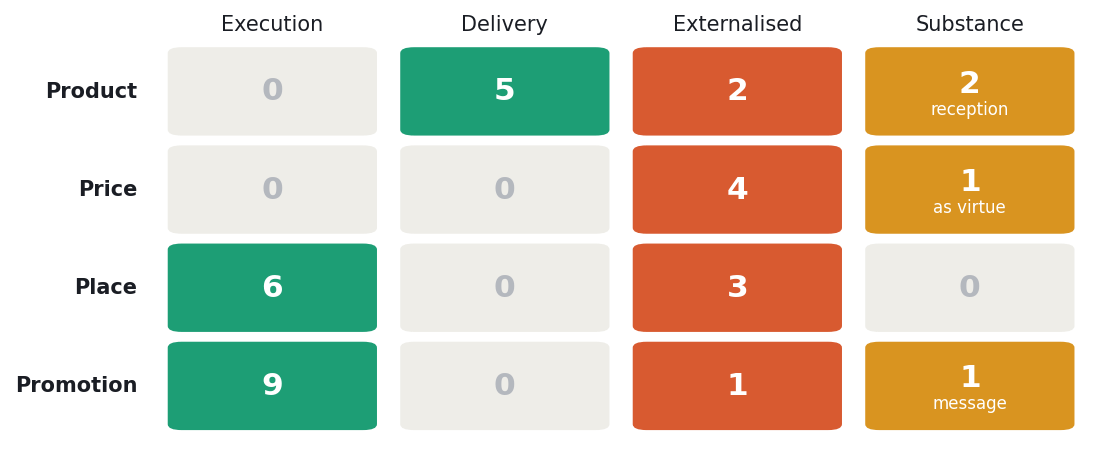
Fig. 6 — Coverage matrix of the causal statements (counts). The product-substance-admitted cell is empty; brand generates no causal statement at all.
The “company” talks, at length and with feeling, about almost everything except whether anyone still wanted what it was selling.
07
The audit: grading the post-mortem
A board reading a CEO’s account of a catastrophic year applies a few tests. The content analysis answers each, and the answers are consistent.
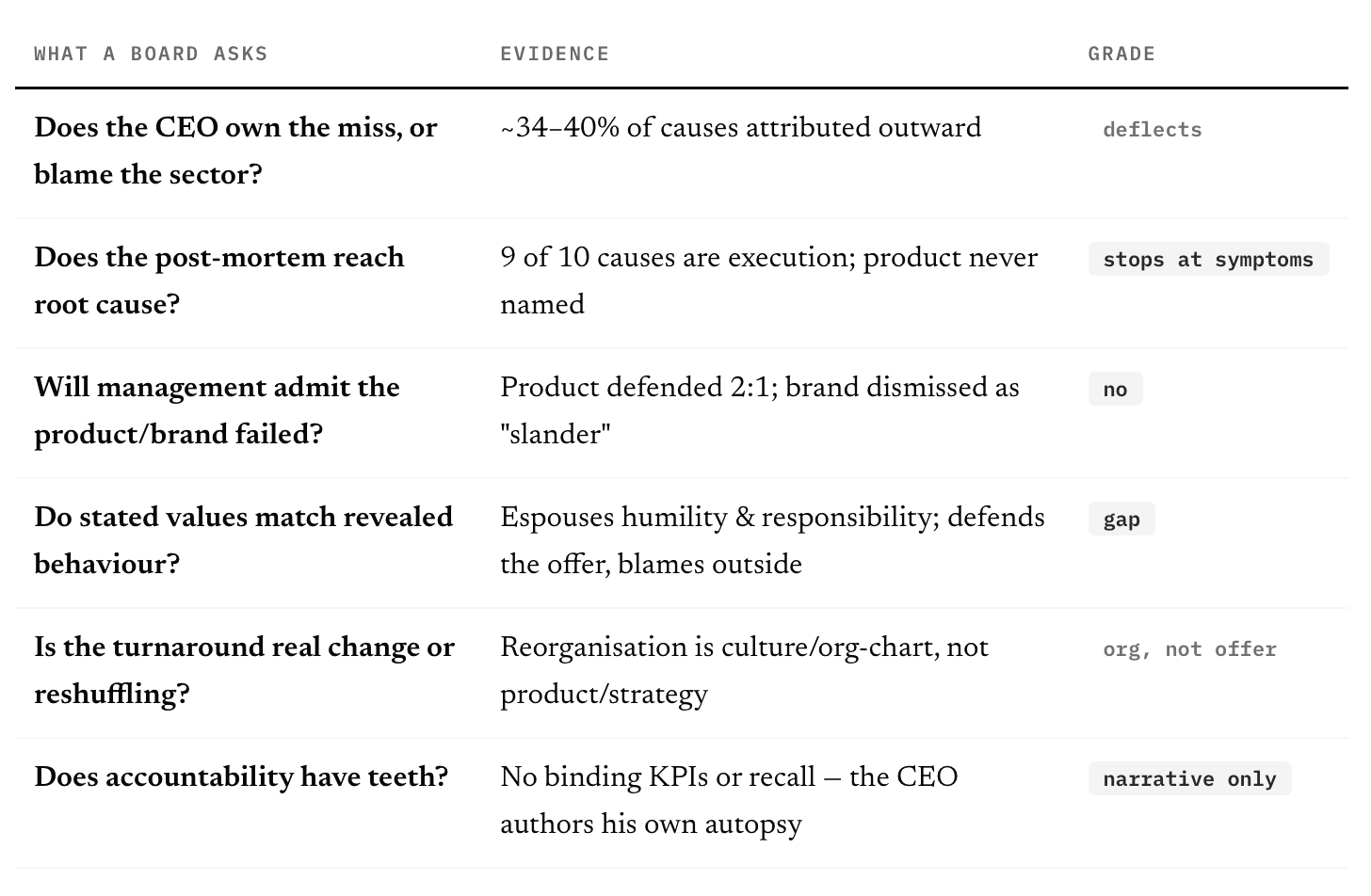
Two rows connect the marketing evidence to the wider argument this series has built. The values gap is an Argyris-style split between espoused values and behaviour, and here it’s measurable: the speech espouses humility and personal responsibility while the coded behaviour defends the product two-to-one and directs two-fifths of the blame outward — the same low-accountability leadership culture, caught in a single specimen. The turnaround is a Kotter question: the reorganisation changes the operating culture and the org chart, not the offer or the strategy. Management is fixing the factory, not the product.
The marketing frame that explains the company’s rise also locates its predicament.
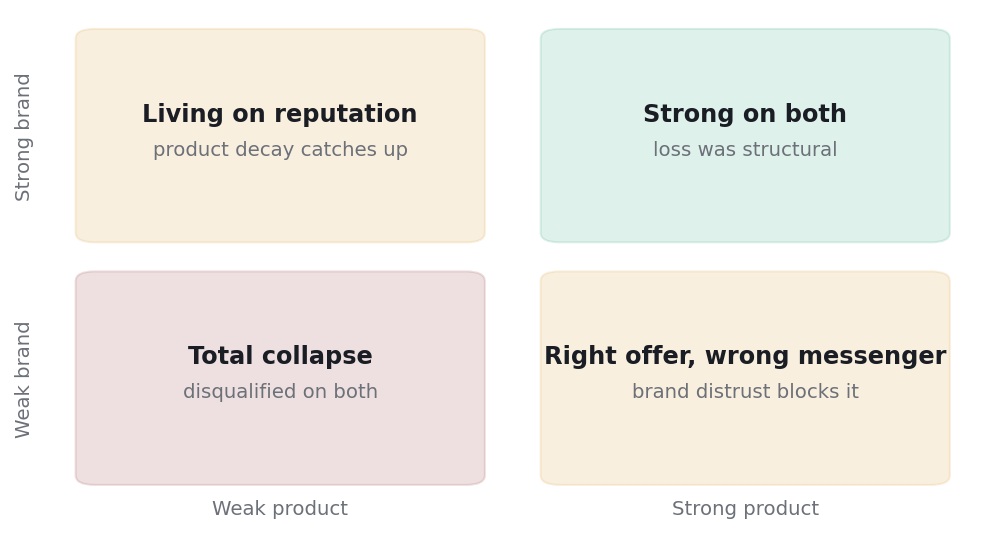
Fig. 7 — Brand health × product quality: the four loss archetypes. The autopsy confronts neither axis.
A defeated incumbent has to confront one axis or the other to diagnose itself honestly. This autopsy confronts neither: it defends the product as a set of successes and treats the brand’s reputation as something done to the company from outside.
08
The prediction, confirmed and the illusion
Recall the mechanism proposed before the defeat: when the product falters, the messaging grows louder. The 2026 speech is the test, and it passes cleanly. The product has now failed in the only way that is unarguable — the company lost its mandate — and management’s response is to defend the product two-to-one and to concentrate its largest outward effort in attack messaging: the opponent’s wealth, the luxury cars, the show-trials. Faced with a product failure, the company reaches for more Promotion, not a product reckoning. A claim made about a party at the height of its dominance is borne out, measurably, in the speech it gave on the way down.
This is what it means to call the model illusionist. Illusionism is not lying; it is the habit of treating a substance problem as a communication problem — of trusting that how a thing is presented can stand in for what it is. For sixteen years the habit paid, and paid handsomely: four supermajorities are not won by weak communicators, and it would be a mistake to wave the craft away as mere spin. But illusions have two ways of failing, and the speech shows both. The first is that the trick stops working on the audience — and it stopped precisely where narrative is hardest to stage-manage, among the young and in the digital space the company itself concedes it lost. The second, quieter and more dangerous, is that the illusionist starts to believe his own illusion: after years of governing by story, the machinery can no longer tell the story from the substance, and so it cannot see that what failed was the product, not the pitch.
09
Conclusion
Judged as what it is — a CEO’s report to shareholders after the worst result in the company’s history — this address is a competent, even candid, campaign post-mortem. It owns the execution failures; the CEO accepts personal responsibility for strategic error; the rebuild is genuine. But it never audits the product, never faults the price, never concedes the brand, and it externalises two of every five words of explanation. The one thing a post-mortem exists to establish — whether the company still makes something people want — is the one thing it does not examine.
That is the price of illusionism, and it arrives in two instalments. The first was the defeat itself: govern by narrative long enough and the gap between the story and the substance widens until, in the arenas you can least stage-manage, reality breaks through. The honest version of this claim is narrow — illusionism did not cause the loss on its own; incumbency fatigue, a capable challenger and real economic weather all played their parts. What illusionism did was let a substance problem compound unaddressed, and delay the reckoning until the bill came due all at once. The second instalment is the one this study actually measures: even now, with the bill delivered, the company cannot name the problem. Handed the clearest substance verdict there is — a lost mandate — it still diagnoses a marketing failure. The illusionist has come to believe his own trick, and a firm that cannot see why it failed cannot fix what failed.
That such a document can be delivered, and its author keep his position, is not a quirk of one speech. It is the predictable output of a system in which the shareholders meet once every four years, the board is captive, the auditors are ignored, and there is no mechanism of recall. Give management sole authorship of the story of its own failure, and this is the story it will write. The remedy is not a better speech, and it is not a better illusion. It is the accountability infrastructure — binding mandates, published performance, real recall — that forces a company to look at the axis it would rather not see. Without it, every post-mortem is, in the end, a press release.
Method & Data
A public transcript of the address to the 32nd party congress (~32 minutes, 2,708 words) was segmented into 252 sentence-level statements, each coded for its marketing-P’s, self/other reference and valence; the 34 statements that explicitly explain the defeat were additionally coded for attribution and depth. Figures are descriptive proportions of a single text, not a statistical sample; all codings are interpretive and published in full in the accompanying methodological factsheet and master coding table, open for re-analysis. A working paper in the Red Card series.
Appendix:
Disagree? Good. I don’t write to be right—I write to be tested. Bring your “Tenth Man” view, your sharpest counterpoint, or even a quiet doubt. Sometimes the most useful critique is the one that unsettles my own thinking.
Don’t forget to subscribe for more Critical Hungary Insights!
AI disclosure: The author supplied the speech transcript and coding scheme; the content analysis was conducted with the assistance of an AI language model (Claude, Anthropic).